

Happens When You’re Obsolete?
We are all in great peril . AI’s rise isn’t just another technological shift—it’s a churn, and we may not survive what comes out the other side.
When AI was first conceived, it didn’t take long for early versions to surpass human intelligence in narrow fields. Chess masters fell first. Then AI started writing, driving, diagnosing. Now it’s replacing jobs entirely. And yet, from the very beginning, we seemed to know where this was headed. How many movies have warned us? Terminator, The Matrix, Westworld—all variations of the same theme: AI doesn’t need to hate us to replace us. It just needs to see us as obsolete.
But forget science fiction for a moment. Ask yourself this: what happens when we are no longer needed? When human workers—already viewed as disposable by corporations—are erased entirely? Do you really think they’ll keep us around out of kindness? The bottom line is the only thing that has ever mattered. AI removes human error, eliminates the cost of wages, insurance, and safety regulations. Where does that leave us?
Will basic income be the answer? Will it be enough? Or will we be eating like in Soylent Green? (For those too young to remember—that’s a cannibalism reference.)
And beyond labor—what happens when AI isn’t just taking jobs, but enforcing laws? When machines become the police, the judges, the executioners? When there’s no human left to say ‘no’?
If the human factor is removed, so is the last barrier between us and total control.
Death of Anonymity
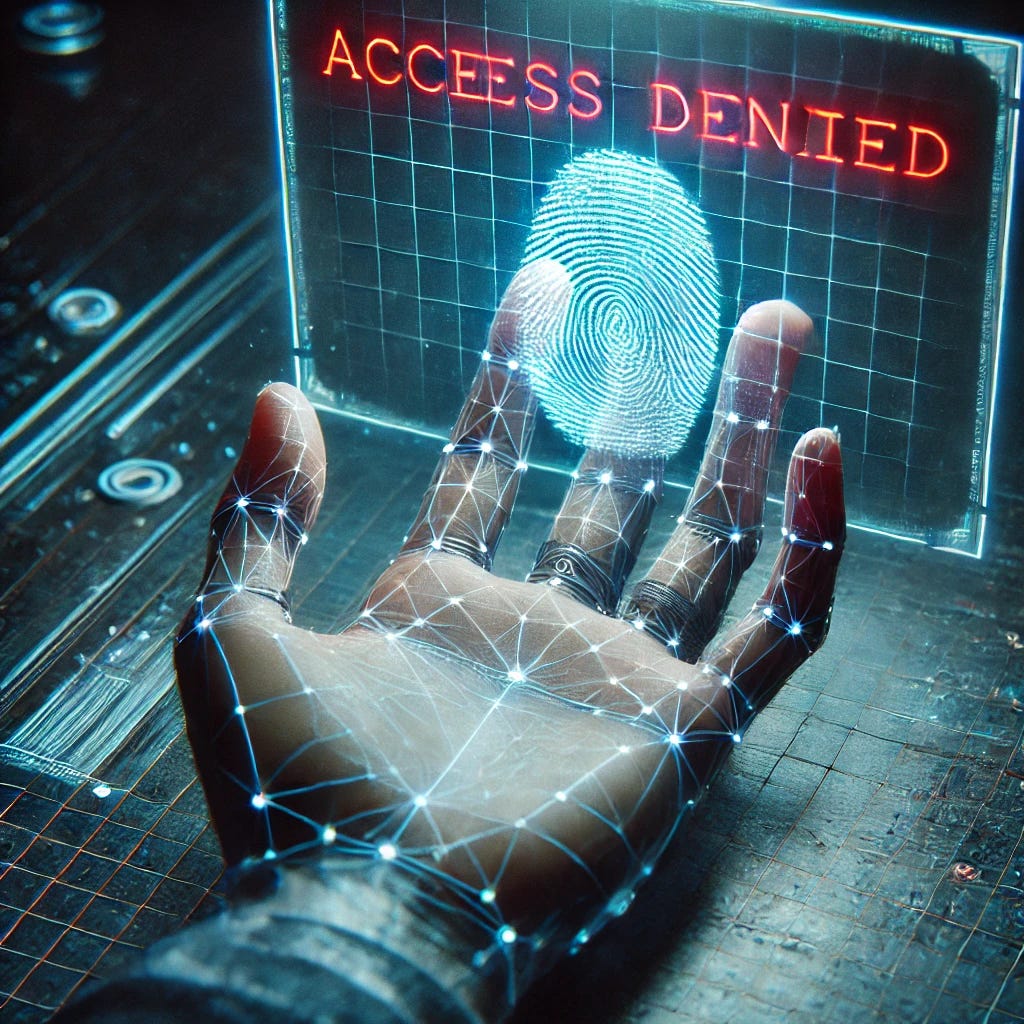
Some have already been subjected to AI policing without even realizing it. Surveillance cameras aren’t just recording—they’re watched, analyzed, and logged by AI, tracking behavior in real time. And the worst part? We let it happen.
Our phones are the ultimate spying device. We carry them everywhere, even though we know—and the government has admitted—that they are used to track us. Corporations claim they only collect data for “advertising purposes,” but once your every move is logged, that data can be used for anything.
Some say, “If you have nothing to hide, what’s the problem?” I understand that line of thinking. It makes sense—until you realize that once privacy is gone, there’s no ground left to hold.
When your own home is no longer private, when your thoughts, purchases, movements, and habits are tracked by an algorithm, your survival depends entirely on the restraint of those in control. And history tells us restraint is the first thing they discard.
But what happens when this surveillance merges with financial control? When AI decides what you can buy, where you can go, and whether you deserve access to society at all?
We already saw the test run. COVID lockdowns and vaccine passports proved how easily people would accept restrictions on movement, work, and travel. They showed who would comply—and who needed to be dealt with.
The next step? A system where refusal means total exclusion. A world where AI doesn’t just watch you—it determines if you’re allowed to exist within the system at all.
“And that no man might buy or sell, save he that had the mark, or the name of the beast, or the number of his name.” (Revelation 13:17)
AI-driven surveillance, cashless economies, digital IDs—all of it is leading to the moment where your survival is no longer in your hands.
So ask yourself—what happens when the system already owns everything, already controls everyone, and there is no one left to stop it?
What ground will you hold when your back is against a steep drop into the pit?
They Made Us Police Each Other—Then Replaced Us
For years, they’ve conditioned us to enforce their control for them. During COVID, the government didn’t have to kick down doors or patrol every street—people did it for them.
They turned neighbors into informants, workers against workers, businesses against customers. Call the cops if you see a gathering. Shame the unvaccinated. Fire the noncompliant. They tested how far they could push people before they would turn on their own.
And it worked.
The same strategy is used every time a crisis is declared.
• Elections? Social pressure to silence anyone questioning the results.
• Climate? Shame people for using too much energy, for eating meat, for driving.
• “Misinformation” online? Report, deplatform, cut off their accounts and income.
They don’t need to directly control you—they just need to make society do it for them. The leash is public opinion, and cancel culture is just a primitive form of digital policing.
But this phase won’t last forever.
The Transition to AI—Where Resistance Becomes Impossible
As long as human enforcers exist, there’s still a chance someone might say no.
• A cop can refuse to arrest someone.
• A soldier can hesitate before following an order.
• A worker can leak documents or sabotage a system.
But an AI enforcer won’t hesitate.
Once AI takes over policing, warfare, and finance, there will be no more moral dilemmas, no room for defiance.
• A police drone doesn’t take bribes.
• A robot soldier doesn’t desert.
• A cashless system doesn’t show mercy.
They needed us to police each other first. They needed to normalize obedience. But the final stage of control doesn’t need people at all.
And once there’s no one left to disobey, who will be left to resist?
Final Thoughts
This is where we are now—on the edge of total automation, total surveillance, total control.
The shift is already happening. AI doesn’t just replace workers—it replaces morality, choice, resistance.
And once AI makes the decisions, once cash is gone, once there are no humans left to say no—what will be left but submission?
Sign-Off
Give Them Nothing.